

October 29, 2026
Authored by Lily Padula
Click to read the full report.
Executive Summary
Illinois is reorganizing its early childhood system through the creation of the Illinois Department of Early Childhood (IDEC). As programs, funding, and administrative responsibilities move into a more unified structure, there is a need for a clear starting point against which future progress can be assessed. This report establishes that baseline for policymakers, system leaders, providers, advocates, and others seeking to understand how Illinois’ early childhood system is performing at the outset of the transition.
The report serves two related purposes. First, it creates a repeatable framework for assessing questions that are often considered separately by program. Are families able to access services? Are those services high quality and inclusive? Is the workforce stable? Is funding adequate and transparent? Are outcomes improving equitably? And does the State have the data systems needed to answer those questions consistently?
The Civic Federation intends to use this baseline in future evaluations of Illinois’ early childhood system, allowing subsequent editions to assess how these measures change as IDEC develops and assumes greater responsibility for programs and services. Because most conditions measured here predate IDEC, this first edition is not an evaluation of the new Department. Rather, it establishes the starting point against which future performance can be measured.
Second, the report identifies areas where Illinois still lacks the information necessary to fully assess system performance. Future editions can therefore track both changes in early childhood outcomes and improvements in the State’s capacity to measure the system itself.
The scorecard organizes the baseline across six domains, or major dimensions of early childhood system performance. These include 1) Child, Caregiver and Family Outcomes; 2) Access and Participation; 3) Quality and Inclusion; 4) Workforce and Provider Stability; 5) Financing and System Performance; and 6) Governance and System Functioning. Equity is examined throughout to show whether access, resources, and outcomes differ across populations and communities.
To summarize performance across a large number of indicators, the Civic Federation developed a scoring framework that assigns each measurable indicator a score based on a defined benchmark. Where possible, benchmarks draw on established federal or State targets, research-based standards, or other recognized measures of performance. Where no established benchmark exists, the scorecard uses a consistent threshold developed for this analysis. Indicator scores are then combined into domain scores and an overall System Index. The grades are intended as a tool for comparing performance across areas and tracking change over time, rather than as an external or independently established rating of Illinois’ early childhood system.
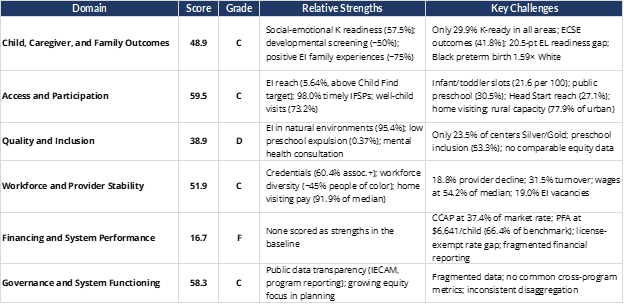
Using this framework, Illinois received an overall System Index grade of C. Four domains received C grades, while Quality and Inclusion received a D and Financing and System Performance received an F. The separate Equity Index received a B, although substantial disparities remain within individual measures. The table below summarizes the relative strengths and key challenges identified within each domain.
Five key findings emerge from the Civic Federation’s baseline assessment of Illinois’ early childhood system.
1. Child and family outcomes are mixed and include substantial disparities. Social-emotional kindergarten readiness and families’ reported experiences with Early Intervention (EI) are relative strengths, but overall kindergarten readiness remains low. Large gaps in kindergarten readiness and preterm birth also show why statewide averages alone are insufficient.
2. Access is uneven by program, age, and geography. Early Intervention (EI) access and preventive health care perform comparatively well, while licensed infant and toddler capacity and participation in publicly funded preschool, Head Start, Early Head Start, and home visiting remain limited. Relatively even distribution across communities does not necessarily mean that overall supply is adequate.
3. The scorecard identifies quality and inclusion as significant areas of challenge. Few licensed programs in the available data reach the higher levels of ExceleRate Illinois, the State’s quality recognition and improvement system for early childhood programs. Only about half of preschool-aged children with disabilities captured by the federal inclusion measure are served in regular early childhood settings for at least 10 hours per week. Illinois performs better on some compliance and discipline measures, but the State has far less information about quality in Family, Friend, and Neighbor and other license-exempt care.
4. The workforce is relatively well qualified but unstable. Many staff in licensed programs have postsecondary credentials, and home visiting compensation approaches the statewide median wage. However, child care wages remain low, turnover is high, the number of licensed providers has declined, and Early Intervention (EI) has a substantial vacancy rate.
5. Financing is the weakest-performing domain. Child care subsidy reimbursement and publicly funded preschool spending fall below the scorecard benchmarks, while Family, Friend, and Neighbor providers receive substantially lower reimbursement than licensed centers. Fragmented financial reporting also makes it difficult to determine where early childhood resources go and whether funding follows need.
The baseline also reveals an important limitation in Illinois’ ability to evaluate the early childhood system. While the State collects substantial program-level data, the data is not yet integrated enough to provide a complete view of how children, families, and providers experience the system across programs and over time. Different programs use different definitions, reporting schedules, and data systems, and some important measures are not publicly available.
As a result, the scorecard identifies several areas where Illinois still cannot fully assess system performance. These include the quality of care outside licensed settings, families’ actual child care cost burden, longitudinal outcomes across programs, the experiences of children involved in the child welfare system, home visiting capacity and utilization, workforce shortages by geography and profession, and the geographic distribution of early childhood funding.
These are not simply technical data limitations. They are accountability gaps. Without consistent and integrated information, policymakers and system leaders cannot readily determine whether new investments, program changes, or governance reforms are improving access, quality, outcomes, or equity, or whether improvements are reaching the populations and communities with the greatest needs.
This is one reason the Civic Federation intends for the scorecard to serve as a recurring evaluation tool rather than a one-time assessment. Future editions can use the same framework to track changes across the six domains while incorporating new measures as Illinois’ data capacity improves. Key signs of progress will include expanded access where supply is most limited, greater availability of high-quality and inclusive care, improved workforce stability, more adequate and transparent financing, narrower disparities, and stronger system-wide reporting.
Over time, comparison with this initial baseline will help show whether consolidation under IDEC is translating into measurable improvements for children, families, and providers.
Click to read the full report.