

May 12, 2026
FREQUENTLY ASKED QUESTIONS (FAQS): TAX INCREMENT FINANCING (TIF)
What is Tax Increment Financing (TIF)?
TIF is a tool used by local governments, like cities, towns, or villages, to boost their economies and pay for redevelopment projects in specific areas. Governments do this by taking property tax revenue above a set starting point and reinvesting it in the same area. The goal is to encourage development that would not happen without this public funding.
How does TIF work in Illinois?
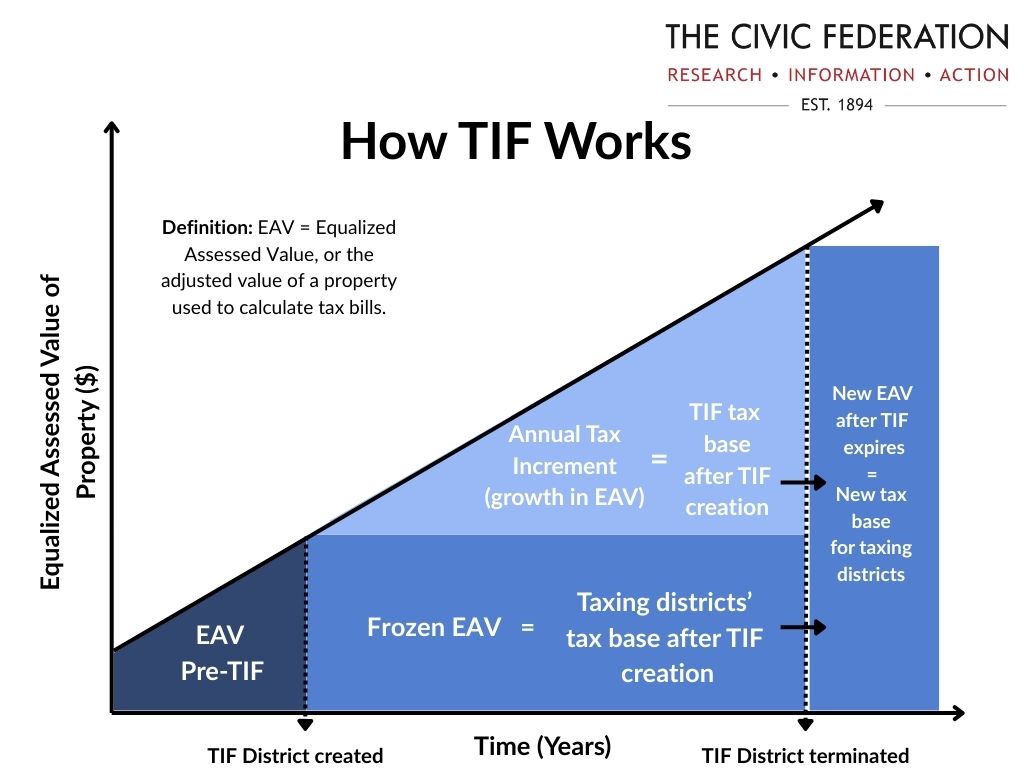
When a TIF district is created, property values in that area are frozen at their current level. As property values increase over time, the extra tax money generated from these increases in value is deposited into a special TIF fund. That fund is then used to pay for redevelopment projects in the same TIF district.
How does a TIF district get made?
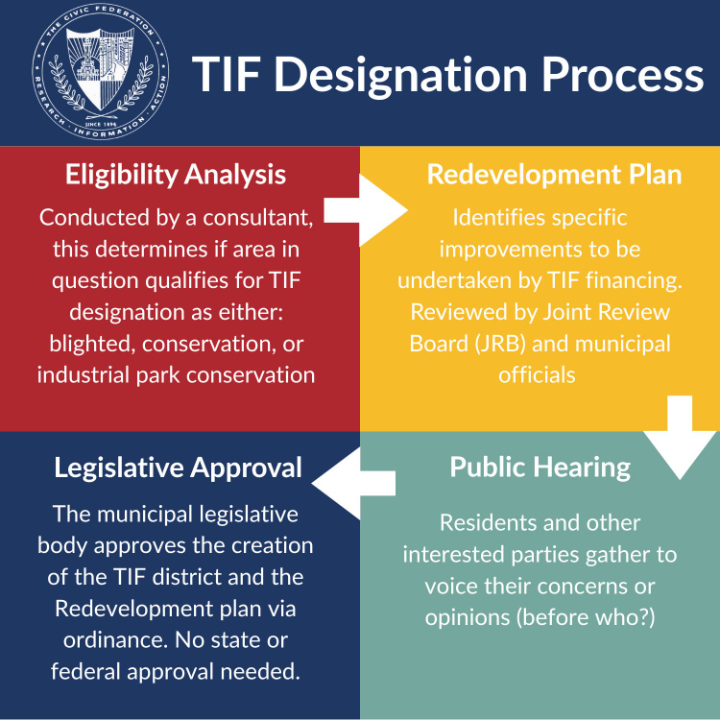
First, a government establishes a geographic area that meets certain eligibility criteria, identifying it as blighted or at risk of blight. Blight means that certain buildings or areas are dilapidated, deteriorated, or obsolete.
The government then prepares a Redevelopment Plan outlining the goals, projects, costs, and financing strategy. There is then a public hearing for residents and other parties to comment, and finally, a government legislative body (such as a city council or county board) approves the district and Redevelopment Plan.
What are TIF funds supposed to pay for?
TIF districts are meant to pay for projects that help redevelop or improve an area that is struggling or underused. The TIF funds pay for things like roads and other infrastructure, building rehabilitation, new development, transit, parks, and other public areas. Funds can also be used to incentivize private developers to spend money in these areas.
Does TIF take away property tax revenues from local governments, like school districts?
No, TIF does not take existing property tax revenues from local governments that have tax caps. These governments set the amount of money they need in property taxes each year (the levy), regardless of whether a TIF exists. An exception to this may occur in counties not subject to tax caps: if a local government is already near its tax rate limit and TIF raises taxpayers’ total tax rate too high, then the government’s revenue might need to be lowered to reduce the overall rate.
How long do TIF districts last?
In Illinois, TIF districts last 23 years, with the possibility of a 12-year extension for a total of up to 35 years.
Does TIF increase property taxes overall?
No. Because TIF does not directly impact a government’s property tax levies, or the total amount of money a government decides to collect in property taxes each year, it does not automatically lead to tax increases. However, it can impact the way taxes are distributed among individual taxpayers.
Do TIF districts raise my individual property taxes?
Depending on where your property is located, potentially yes. Because TIF reduces the available property governments can tax, they can lead to higher tax rates for taxpayers to make up for the fact that governments still seek the same amount of revenue from a smaller tax base. This means that taxpayers may pay higher tax rates during the life of the TIF districts. However, after the TIF district expires, property owners may see a decrease in tax rates as the previously frozen property value returns.
How many TIF Districts are there in Illinois?
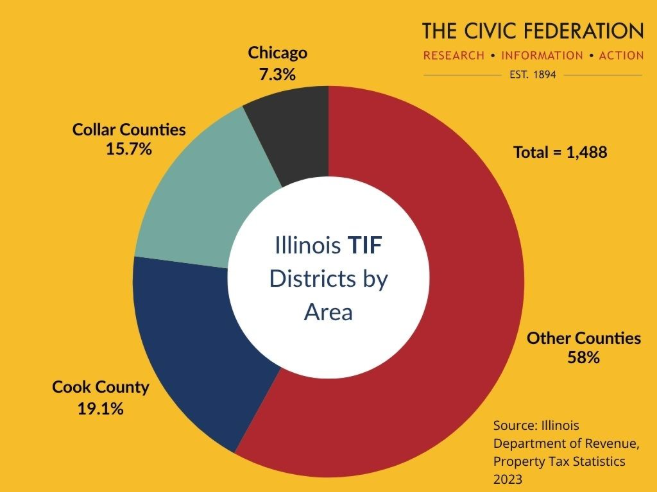
There were 1,488 TIF districts statewide as of 2023. They are broken down geographically in this chart:
How many TIF Districts are there in Chicago?
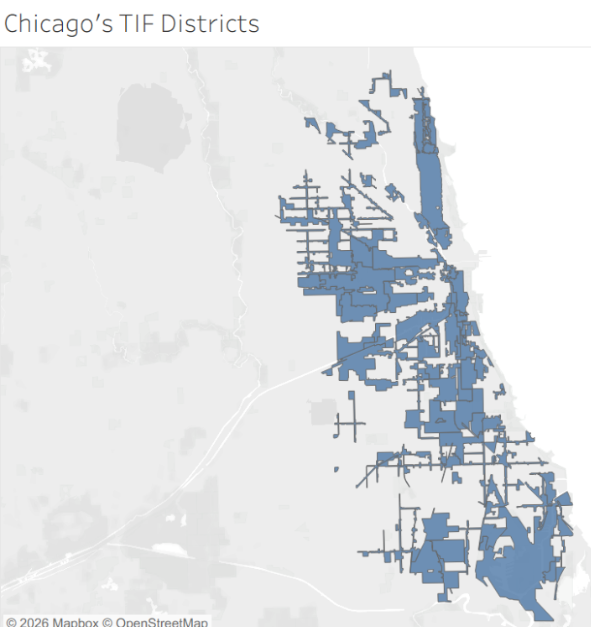
As of April 1, 2026, there are 108 active TIF districts within Chicago. About a quarter of all properties in the City are located within a TIF district.
How much revenue do Chicago TIF Districts generate each year?
In recent years, TIFs have generated between $1-1.5 billion in revenue across all TIFs in Chicago combined. This has increased significantly over the years. For example, in 2015, all Chicago TIF districts generated $372 million and in 2024, they generated $1.4 billion—an increase of 266%.
How does TIF impact the value of property?
Typically, the value of property in a TIF continues to grow above the baseline from when it was created. For example, in Chicago, the value of property within TIF districts has grown significantly, by 256%, from $5.4 billion in 2015 to $19.3 billion in 2024.
What is TIF Surplus?
When revenue generated by a TIF district exceeds the amount needed to pay for current or planned redevelopment projects, it is considered “surplus.” State law requires municipalities in Illinois to declare a TIF surplus annually and redistribute that money back to overlying taxing agencies.
What happens with the TIF surplus?
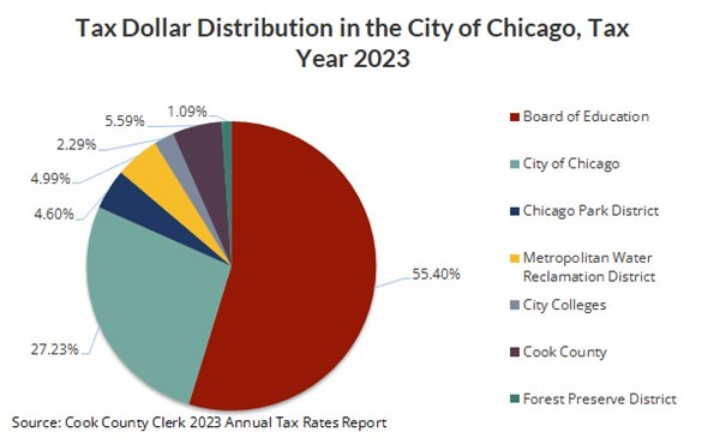
State law requires that the surplus money be distributed to all local overlapping governments based on their share of property taxes. First, the municipality identifies how much TIF money is left over each year after paying for redevelopment costs, debt service, and other contractual obligations. Then the county clerk distributes the excess property tax funds to each taxing body based on their proportional share of the overall property tax rate. This essentially follows the same formula used for normal property tax distributions. The governments receiving the TIF surplus can then use that property tax revenue for any purpose.
- In Chicago, the TIF surplus is distributed according to the following breakdown of overall tax bills:
How much is declared in TIF surpluses?
In Chicago, the amount of TIF surplus has been growing over the years because of increases in the amount of revenue going to the TIFs as property values have gone up, while the cost of projects within the TIF districts has not increased at the same rate. The City of Chicago declared its largest-ever TIF surplus of $1 billion in 2026.
Why is TIF surplus so controversial in Chicago?
When Chicago takes the extra money from TIF accounts, governments get large and flexible amounts of funding that they can use for general expenses. The City and Chicago Public Schools both face massive budget gaps, and TIF money helps close those gaps without raising taxes or cutting services.
However, there is debate about relying on TIF funds because they are not a permanent source of revenue, and they are intended to be used for redevelopment. Some elected officials argue that governments should reduce their reliance on TIF so they are better prepared when those funds are no longer available.
How are TIF projects financed?
TIF projects may be paid for using the increase in property tax revenue that comes from rising property values within the TIF district. In most cases, the municipality borrows money by issuing bonds and then pays it back over time using the additional tax revenue. Sometimes the municipality uses a pay-as-you-go approach, covering project costs as new tax revenue comes in rather than borrowing. In other cases, a private developer pays for the project up front, and the municipality reimburses them later using the increased property taxes.
What happens when a TIF district ends?
When a TIF expires, the full property value is returned to the tax base, allowing all taxing bodies to access the increased value. Taxing agencies must levy taxes for the increased property value from the expiring TIF in order to capture the increased revenue in that year. This can result in greater revenues and potentially lower tax rates.
Is TIF “good” or “bad”?
Tax Increment Financing (TIF) is neither inherently good nor bad—it is a tool. Its effectiveness depends on how, where, and why it is used. TIFs can be effective in promoting development in targeted areas—but they also involve tradeoffs, particularly around transparency, equity, and the allocation of tax revenues. Evaluating whether a specific TIF is “good” or “bad” requires looking at how well it is designed, implemented, and aligned with broader community goals.
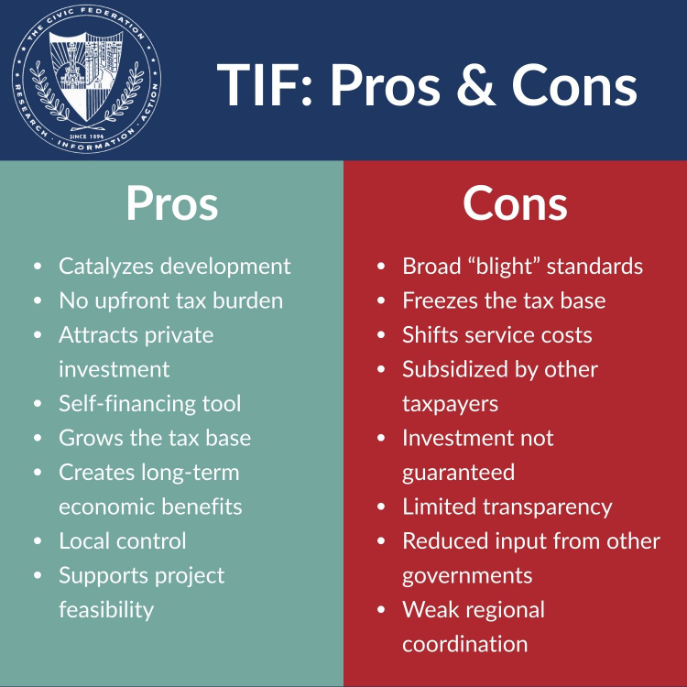
Supporters argue that TIF can encourage development that would not otherwise occur by helping close financing gaps and attract private investment, jobs, and business activity to underdeveloped areas. Because TIF relies on future increases in property tax revenue, it can fund redevelopment without drawing on general operating funds. Proponents also emphasize that TIF districts can generate long-term growth in the tax base once they expire and give municipalities flexibility to pursue locally driven development priorities.
Critics argue that TIF can subsidize development that may not truly require public support, particularly when broad definitions of blight are used. They also raise concerns that TIF districts divert property tax revenue for decades, limiting funding available for core services like schools and shifting costs to taxpayers outside the district. Additionally, critics note that TIF does not guarantee economic returns, can lack transparency and input from overlapping taxing bodies, and may not align with broader regional planning goals.
What is the impact of TIF?
According to policy studies, TIF can be effective at stimulating development within designated districts, particularly in commercial and industrial areas. However, most research suggests that TIF does not produce significant overall economic growth at the municipal level. Gains within TIF districts are often offset by slower growth elsewhere, and the presence of TIF can create fiscal and equity tradeoffs, such as reduced revenue for overlapping taxing bodies and uneven distribution of benefits. Evidence on whether TIF consistently induces development that would not have happened otherwise—the so-called “but for” test—is limited and mixed.
Which government is in charge of creating and monitoring TIF Districts?
Illinois law allows counties, cities, or villages to create a TIF district. Once created, those governments manage and monitor TIF district projects.
What Role Do Local Stakeholders Play in the TIF Process?
TIF districts as well as development projects may be proposed by the city government, City Council members, developers, and/or community groups.