
July 29, 2026
By Daniel Vesecky
The Chicago Public Schools (CPS, or the ‘District’) is lacking the cash that it needs to meet operating costs. The crunch has become so bad that CPS’ finance team has voiced concerns about an inability to make payroll in September if a FY2027 budget is not passed by the end of July. This piece will explain what this cash shortage is, how it came about, and what CPS can do to alleviate it.
What Does ‘Not Enough Cash’ Mean?
Every year, CPS must pass a budget that accounts for all the revenues it expects to gain that year and all the expenses it expects to pay. The budget is legally required to be balanced, meaning that revenues must be equal to or larger than expenditures. If the budget isn’t balanced, CPS will not have enough money to pay the bills and could be forced to make cuts in the middle of the year. The same is true for every unit of government that must pass an annual budget.
But simply passing a budget does not make the revenues it projects materialize instantaneously. Those revenues are distributed throughout the year, and sometimes they can appear after expenses are owed. For example, most of CPS’ revenue comes from property taxes, the vast majority of which are not delivered to the District until February. Since CPS’ fiscal year runs from July 1 to June 30 (mirroring the school year), this is quite late.
It is generally considered good fiscal practice for governments to keep a certain amount of cash ‘on hand,’ meaning that it is sitting in a bank account, in reserve in case it is needed. This is useful for two reasons. First, it can provide surplus funds to resolve cash flow issues. If a government’s expenses come due before it receives expected revenues, it can use some of its cash reserve and then replenish it when revenues come in later in the year.
The second reason cash reserves are useful is that they provide a cushion in case expenses are higher than expected or revenues are lower. For example, if an economic downturn strikes halfway through the year, the State of Illinois might find its income tax receipts lower than projected. In that case, it can draw on its cash reserve to balance its budget, rather than enacting mid-year cuts. Cash reserves used for this purpose are often called ‘rainy day funds,’ and generally should not be used outside of emergency or one-time scenarios. Regularly using rainy-day money to pay for operating costs is a sign of an extremely fiscally unhealthy government.
Simply put, CPS does not have a cash reserve – not even a single dollar. This means that when expenses come in before revenues – which they always do due to the property tax and tax increment financing (TIF) surplus timelines – the District has no available reserves to tide it over. Instead, it must borrow money to pay its bills, and the interest on that borrowing is an additional expense the District must take on.
Why Doesn’t CPS Have Any Cash?
When CPS’ pension holiday expired in 2014, the District began to experience severe budget deficits. These deficits were exacerbated by the State of Illinois’ budget impasse, which stretched from 2015 to 2017 and drastically reduced CPS’ dependable State funding. The District’s response to this financial crisis was to implement a variety of one-time measures that closed individual budget gaps but did not address the structural deficit of having persistently more expenses than revenues. The failure to implement long-term solutions means that the deficit reappears year after year, necessitating more one-time measures.
One of the ways that CPS closed budget deficits in the early 2010s was by using its cash reserve. At the end of FY2011, before the 2010s funding crisis, the District had a reasonably healthy cash reserve of $476 million. With a total budget of $6.3 billion in that year, this was a cash reserve of over 7% of operating funds. By the end of FY2015, almost all the existing fund balance had been used to balance budgets and cover operating costs, and the remaining $72 million was exhausted soon after. Although CPS eventually emerged from the funding crisis with the 2017 passage of the State’s Evidence-Based Funding (EBF) law, which drastically increased State support of CPS, it carried essentially $0 in cash reserves by this time.
Since then, CPS has continued to struggle with budgetary pressures brought on by rapidly increasing expenses, high capital needs, and the additional costs imposed by the COVID-19 pandemic. Although federal stimulus funding helped cover some of these issues in the early 2020s, in recent years sizeable budget deficits have begun to reemerge. As a result, CPS has been focused on immediate fiscal pressures and has not had the chance to begin rebuilding its cash reserve. Going into FY2027, it continues to have a fund balance of $0.
What Does this Mean for CPS?
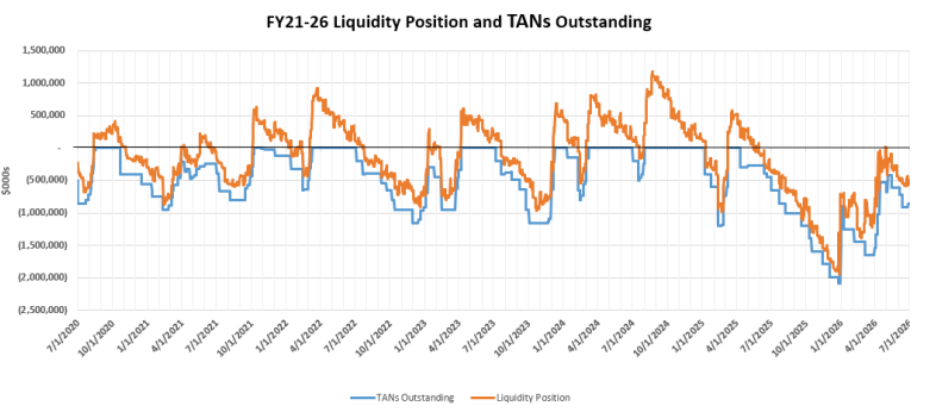
As discussed earlier, cash reserves have two main functions: they act as a buffer when revenue and expenses are out of sync, and they provide a source of funding in case of emergency. Without a cash reserve, CPS is deprived of these tools. This means that the District is forced to go into debt to meet payroll and cover expenses while it waits for revenue to arrive later in its fiscal year. This debt comes in the form of Tax Anticipation Notes (TANS), which are short-term loans taken out by CPS with a guarantee of repayment from the revenue that the District expects to receive later in the year. In FY2026, CPS had a maximum of $2.1 billion in TANs outstanding at once.
There is a cost to managing CPS’ cash flow problems with TANs instead of with a cash reserve. These short-term loans may not last long, but they still require interest payments over their lifetimes. In FY2026, the District estimated that it paid $43 million in interest costs on TANs alone. That is $43 million less that could otherwise be directed to classrooms, mitigating cuts, or even beginning to rebuild the District’s cash reserves.
CPS’ interest costs were especially severe in FY2026 because Cook County experienced delays in its property tax collection system that led to tax revenue being distributed significantly later than usual. The District did not begin to receive property tax revenue until late March 2026. Consequently, it had to borrow more and extend its TANs for longer to keep up with operating expenses. In fact, CPS is still missing revenues for FY2026, and it will have to extend TANs from the 2026 fiscal year into the 2027 fiscal year because it has not yet received the full disbursement of expected property taxes. The following chart illustrates how CPS’ reliance on TANs has grown in the 2026 fiscal year. Cook County’s inability to distribute tax revenue in a timely and organized fashion has made CPS’ fiscal picture notably more difficult and has complicated its already concerning cash flow problems even further. It will be difficult for CPS to extricate itself from its current cash issues until the County stabilizes the property tax assessment and collection system.

In addition to relying on TANs to meet cash flow needs and incurring interest costs, the lack of cash reserves also leaves CPS without a source of emergency funding. This means that if the District were to encounter unexpected costs or a sudden downturn in revenue, it would be unable to cushion the blow and would be forced to make mid-year spending cuts. In short, the absence of a rainy-day fund makes budgeting a much higher-risk project for the District.
Additionally, credit rating agencies take this problem very seriously. Without cash on hand, CPS is seen as a higher-risk institution to loan to if it has no cash on hand, as it may need that cash to make regular interest and premium payments on its loans. The District’s junk-status credit rating raises the cost of borrowing, increasing its interest costs for long-term loans and decreasing its ability to fund capital and maintenance projects. It will likely be difficult for the District to improve its credit rating without building a substantial cash reserve.
How Can CPS Fix This?
The best – indeed the only – way that CPS can solve its cash problems is by beginning to build a reserve. This cannot happen overnight – the District will have to commit to saving a small portion of its annual budget for many years in order to reach a reserve sufficient to truly act as a rainy day fund. However, incremental progress in this direction will still be helpful. Every dollar in a cash reserve is one less dollar the District will need to borrow through TANs, thereby generating annual savings in interest costs. Additionally, credit rating agencies will likely view a consistent increase in the District’s reserves as a positive step and could begin to reverse the District’s junk-status. Indeed, in its review of CPS’ 2025 debt issuances, S&P cited a ‘positive fund balance trajectory’ as one of the things that might lead it to upgrade CPS’ credit in the long term.
The Government Finance Officers Association (GFOA) recommends a minimum fund balance sufficient to cover two months of general fund expenditures for large governments, or 16.7% of the general fund. CPS’ FY2027 proposed general fund is $7.2 billion, so this standard would suggest a minimum goal of $1.2 billion. However, the GFOA also notes that cash flow issues, volatile revenue sources, and low bond ratings are all reasons to err on the side of a larger cash balance. It would thus make sense for CPS to aim, in the long run, for a cash balance well above the minimum threshold set by the GFOA’s recommendation. An additional $1.2 billion would be approximately sufficient to cover CPS’ normal TAN needs (in years before the County’s tax distribution problems). This would suggest that a benchmark of around $2.5 billion would be a wise long-term goal for CPS to build its cash reserve up to.
$2.5 billion is a very difficult threshold to reach, but CPS does not have to reach it all at once. By setting even a small amount of cash aside each year, CPS can begin working toward a healthier cash balance and signal to the State, the credit rating agencies, and Chicago voters that it is trying to be more fiscally responsible. In a time of high deficits, building a strong cash reserve may seem like an impossible task. But, ironically, a reserve is one of the tools that could help CPS to escape the perpetual crisis that it faces today.